How WhatsApp Automation & AI Chatbots Help Indian SMBs Stop Losing Leads
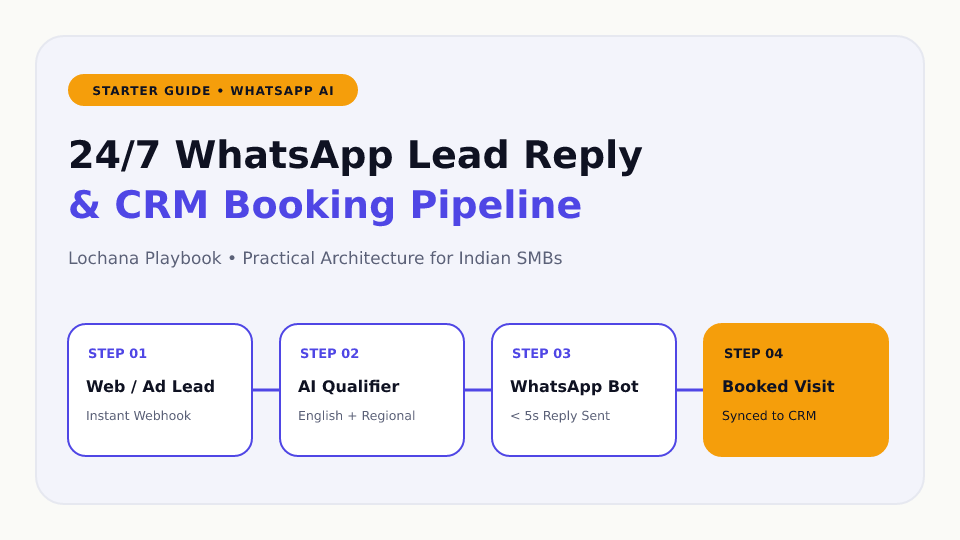
Why fast replies matter more than bigger ad budgets
Whether you run a dental clinic, a real estate sales desk, or a D2C brand, prospects usually message two or three providers at the same time. The business that replies clearly in the first couple of minutes almost always wins the conversation.
Yet small teams cannot stare at WhatsApp at 10 PM or during busy customer hours. That gap is where qualified leads quietly slip away.
What a good WhatsApp + AI workflow actually looks like
Effective WhatsApp automation for business is not a frustrating menu of 'Press 1, Press 2'. Modern workflows combine official WhatsApp Business API templates with a tightly scoped AI assistant trained only on your real services, timings, locations, and FAQs.
When a new enquiry arrives from your website, Google Business Profile, or Meta lead form, an n8n workflow can greet the prospect by name, ask two simple qualifying questions, share a relevant brochure or booking link, and log the entire thread in your CRM or Google Sheet.
- Instant acknowledgement within seconds—even on Sundays and holidays
- Polite qualification (service needed, preferred city/branch, timeline)
- Automatic calendar slot or callback scheduling
- Immediate human alert when a high-intent buyer asks to speak with your team
Where to keep humans in the loop
AI should handle repetitive first-touch questions and scheduling—not negotiate sensitive custom quotes or medical advice. Every assistant we build at Lochana has clear guardrails: if a question falls outside approved business facts, it hands the chat smoothly to a team member with a clean one-line summary.
Starter checklist before you automate
Before setting up an AI chatbot for business in India, write down your top 15 customer questions, your working hours, and the exact next step you want a qualified lead to take (book an appointment, request a quote, or schedule a site visit). With those three pieces clear, launch takes days rather than months.
What the first ten minutes actually cost you
It is worth putting a rupee figure on the delay. Take a clinic that spends ₹60,000 a month on ads and receives 200 enquiries. If four in ten go cold before anyone replies, that is 80 lost conversations. At a modest 20 per cent conversion and a ₹4,000 average treatment value, the silent loss is roughly ₹64,000 a month — more than the ad budget itself.
The arithmetic changes the conversation. Businesses usually reach for a bigger budget when the fastest return is replying to the leads they already paid for. Automation is not primarily a cost-saving measure; it is a revenue-recovery measure.
The same maths applies to real estate, coaching institutes and equipment dealers. Anywhere a lead is time-sensitive and enquiries arrive in bursts, the bottleneck is first response, not reach.
The WhatsApp Business API question
There are two very different ways to automate WhatsApp, and choosing the wrong one wastes a quarter.
The first is the unofficial route: a library that logs in as a WhatsApp Web session. It is cheap, works in an afternoon, and violates WhatsApp's terms. Numbers get banned, sometimes after a year of happy use, and the business loses its conversation history along with the number.
The second is the official WhatsApp Business API through a provider. It is compliant, handles templates and rich messages properly, and supports multiple agents on one number. It also carries per-conversation charges, requires business verification, and needs template messages approved in advance for outbound messages.
For a business whose enquiries come from ads and its own website, the official route is the one that survives. Plan for two to three weeks of verification and template approval before launch day, not two days.
- Unofficial session libraries: fast, cheap, bannable — not advisable for a business number
- Official API: compliant, supports teams and templates, has per-conversation fees
- Business verification takes days to weeks; start it before you need it
- Outbound template messages need approval; inbound replies do not
- Keep a fallback channel (call, email) for when a number is temporarily restricted
What to measure once it is live
Automation that is not measured quietly degrades. The three numbers worth a weekly glance are time to first reply, the percentage of enquiries that reach a booked appointment or a human, and the percentage of automated conversations that a human had to rescue.
If first reply time is excellent but booked appointments are flat, the bot is answering but not qualifying. If rescue rate climbs above roughly one in five, the automation is answering the wrong questions and should be retuned rather than expanded.
Everything else — message counts, open rates for WhatsApp — is vanity at this scale.
Want help setting this up for your business?
Book a free audit with Lochana and get a clear, fixed-price plan tailored to your team.