What a Business Website Actually Costs in India — and What Drives the Price
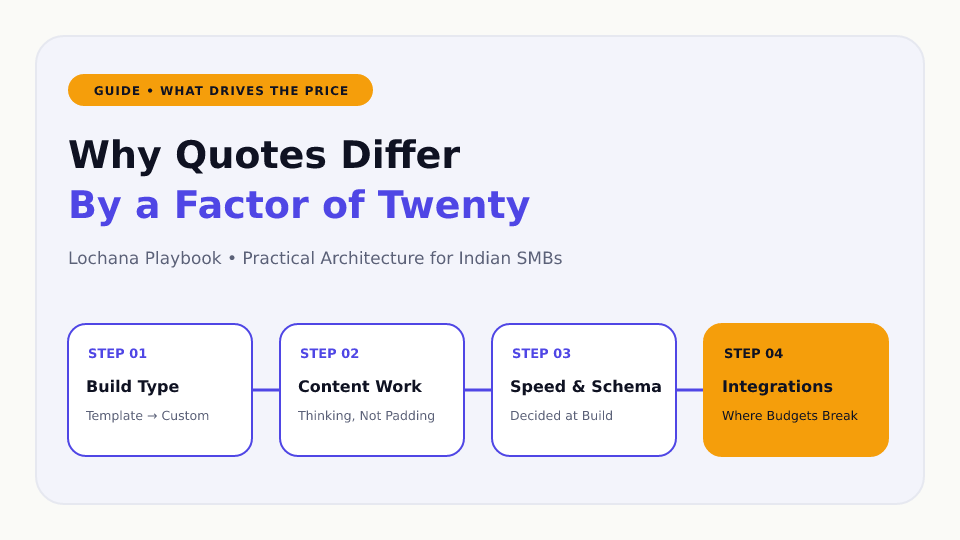
Why we are not publishing a price list
Almost every "website cost in India" article you will find opens with a table of packages: basic ₹9,999, standard ₹24,999, premium ₹59,999. Those tables are written to be indexable, not accurate. When you email the company, the actual quote is different, because the packages were never real.
The honest answer is that cost is driven by about six decisions, and the same brief can legitimately cost ₹30,000 or ₹3,00,000 depending on how you answer them. A useful article explains the decisions rather than inventing numbers.
What follows is the cost structure we use internally when scoping, described in plain terms. It applies whether you hire us or not.
Decision one: template, custom design, or custom build
A template site — a purchased theme on WordPress or a builder like Wix — is the cheapest option and is genuinely fine for a business that needs a credible five-page presence and does not intend to compete on search.
A custom-designed site typically means an experienced designer starting from your content and brand, usually still on a CMS. This is where most serious small businesses land: it does not require a developer for every text change, but it is not the same layout as three thousand other sites.
A custom build — hand-coded, component-based, no page builder — costs the most up front and buys you speed, structured data, accessibility and a codebase that a developer can extend rather than fight. It is the right choice when the website is a lead engine rather than a brochure.
- Template: fastest, cheapest, weakest performance ceiling, hard to differentiate
- Custom design on a CMS: good balance for content-heavy business sites
- Custom build: highest up-front cost, best performance and long-term extensibility
- Beware the trap in the middle: an expensive theme with a cheap developer produces the worst of both
Decision two: how many pages, and how much of it is thinking
Page count is the crude measure everyone quotes and the least useful one. Ten pages of lifted content cost less and perform worse than five pages written properly.
The real driver is whether someone is doing content and structure work: figuring out what customers search before they buy, writing the copy that answers it, and organising the site so each page has a job. That work is usually a meaningful share of a good project's cost, and it is the first thing cut in a cheap quote.
If a quote includes "content writing" as a line item at a suspiciously low price, ask who is writing it and whether they will interview anyone in your business. Generic copy is the most common reason a technically fine site never ranks.
Decision three: performance and technical SEO are build-time decisions
Speed is not a plugin you add at the end. Whether a site scores well on Core Web Vitals is decided by the framework, the image pipeline, the number of third-party scripts, and whether content is server-rendered.
Retrofitting performance onto a heavy builder site often costs more than building correctly the first time, and sometimes is not achievable at all without a rebuild.
The same is true of structured data, clean URL structure, sitemap generation, and accessibility. These are cheap during the build and expensive afterwards, which is precisely why they are absent from low quotes.
- Ask what the framework is, and whether the HTML is server-rendered or JavaScript-only
- Ask how images are processed — automatic resizing and modern formats or manual uploads
- Ask for a Lighthouse or PageSpeed score on a comparable site they have shipped
- Ask whether schema markup and a generated sitemap are included or extra
Decision four: integrations are where budgets quietly break
A site that collects leads into an email inbox is a different project from one that writes them to a CRM, sends a WhatsApp acknowledgement, assigns an owner, and appears on a dashboard. Each of those is an integration, and integrations are where estimates go wrong.
Payment gateways, booking calendars, inventory feeds, GST invoicing and WhatsApp Business API connections all carry their own setup, credentials, testing and failure modes — plus third-party fees that are separate from the build.
The question to ask before signing: how many systems does the website need to talk to, and does the quote list them by name? A quote that says "CRM integration included" without naming the CRM is a placeholder, not a commitment.
Decision five: ongoing cost, the part quotes usually omit
A website is not a one-time purchase. Domain, hosting, a CMS licence if applicable, an SSL certificate if not bundled, email hosting, and some arrangement for updates and backups all recur.
These are individually small but they add up, and the arrangement matters more than the total. A site that nobody updates for two years will develop broken contact forms and stale content long before it looks visibly old.
Decide up front who handles: security updates, plugin or dependency updates, backups, content changes, and what the response time is when the site goes down on a Saturday. If the answer is "we will call you", clarify what you are paying for that call.
- Domain and hosting renewal, and who owns the accounts
- Content change requests: included hours or billed hourly
- Security and dependency updates, and how often
- Backups: where they live, and whether a restore has ever been tested
- Analytics and search console ownership — insist it stays in your name
How to read a quote so you can compare it fairly
The single most useful thing you can do before requesting quotes is write a one-page brief: who the site is for, the five searches you want to rank for, what a visitor should do, and which systems the site must connect to. Send the identical brief to every agency.
Quotes against an identical brief become comparable in a way quotes against a vague idea never are. You will still see a wide range, but now you can see whether the difference is scope, quality, or someone guessing.
And treat a suspiciously low quote as a question rather than a bargain. It usually means content is being copied, performance is being ignored, or the integration work will be charged later as "extra".
Red flags worth walking away from
Some patterns reliably predict a bad outcome regardless of price. If you see two or more of these in a proposal, the cheapest quote is likely to be the most expensive decision.
- The agency will not tell you which platform they will build on
- Domain and hosting are registered in the agency's name, not yours
- No mention of who owns the code or the content after delivery
- A guaranteed "first page of Google" claim with no explanation of method
- No staging or preview link before launch
- Testimonials with no company name, role or link to a real site
Want help setting this up for your business?
Book a free audit with Lochana and get a clear, fixed-price plan tailored to your team.