Google Business Profile Optimisation: A Complete Checklist for Indian Businesses
Why the profile matters more than the website for local searches
When someone searches "dentist near me" or "fabricator in Chakan", the result that gets the call is usually the local pack — the three map results above the normal links. Your Google Business Profile, not your homepage, is what appears there.
That inverts the usual SEO priorities for local businesses. A perfect website that feeds a neglected, half-filled profile will lose to a competitor with a complete profile and a mediocre site.
The good news is that most profiles in Indian cities are poorly optimised, so the work below tends to produce visible movement faster than on-page SEO does.
Start with the fundamentals people skip
Before any clever tactics, confirm the basics are complete. Google's own guidance is that complete profiles earn meaningfully more actions than incomplete ones, and completeness is judged relative to your category.
The two fields that carry the most weight and get the least attention are the primary category and the business name. Both are frequently wrong in ways that actively hurt.
- Claim and verify the profile — an unverified profile cannot be optimised at all
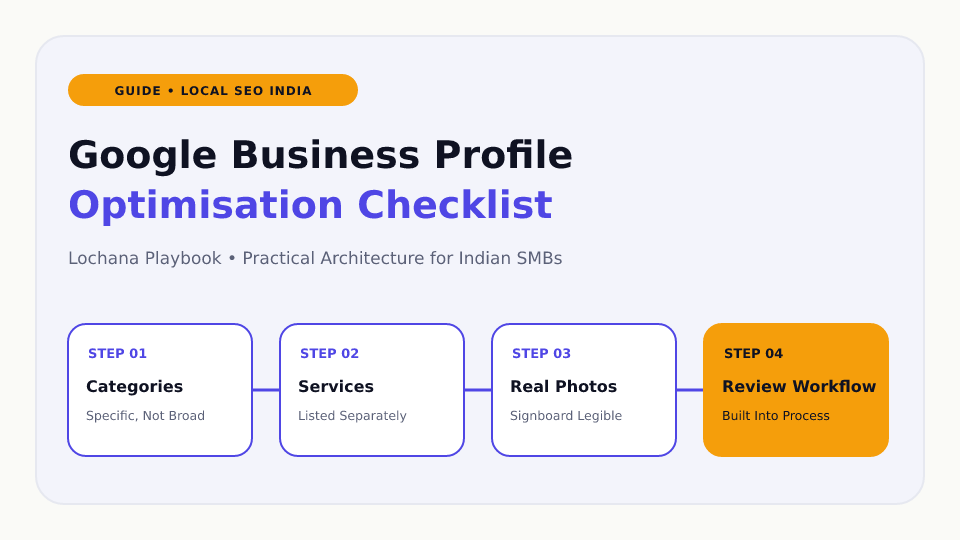
- Choose the most specific primary category available, not the broadest one
- Add two to five secondary categories that reflect real services you deliver
- Use the exact legal or trading name — no keyword stuffing, which risks suspension
- Set opening hours accurately, including the awkward ones: lunch closures, Sunday, festivals
- Add a real local phone number that a human answers during working hours
- Set the service area only if you genuinely travel to customers
The name-stuffing problem in Indian cities
Search any service in a mid-sized Indian city and you will find profiles named things like "Sharma Dental Clinic Best Dentist in Andheri Mumbai". These rank today and are a liability tomorrow: they violate Google's naming guidelines, compete unfairly, and are regularly removed after a competitor reports them.
Meanwhile, a legitimate business gets outranked by them and concludes that keyword stuffing works. It does, briefly, and then the profile disappears and the phone stops ringing with no explanation.
If a competitor is doing this, the productive move is to report the listing through the business redressal form rather than to imitate it. If your own profile was set up this way by an earlier agency, fix the name before anything else — the risk is not worth the temporary lift.
Services, descriptions and the words that actually get searched
The business description is capped at 750 characters and does not accept links. Treat it as a plain-language explanation of what you do and who for, using the words customers use rather than industry jargon.
The Services section is more valuable than most owners realise, because individual services can rank for long-tail searches on their own. A dental clinic listing "Root canal treatment", "Dental implants" and "Braces and aligners" as separate services with short descriptions gives Google three concrete things to match, instead of one vague category.
Write each service the way a customer would search it, then one sentence on what it involves. Skip the marketing adjectives; there is no room and no benefit.
- List every core service separately, with a short description on each
- Use customer vocabulary — "teeth cleaning", not "prophylaxis"
- Add products if you sell physical goods with a defined specification
- Put the city and locality in the description naturally, once each
- Never paste the same description into every field to pad keywords
Photos: what to upload and how often
Photos are a ranking and conversion signal simultaneously. Profiles with recent, genuine photos get more direction requests and calls than profiles with a single logo as the cover image.
The photos that perform best are boringly literal: the shopfront with the signboard readable, the interior with lighting that matches reality, the team at work, and photos of the actual product or treatment room. Stock imagery of smiling models is transparently fake to a local buyer.
For Indian businesses specifically, add a photo of the street context and parking entrance. A large share of calls from Maps are from people trying to work out whether they can find and park at the location.
- Cover photo: exterior with signboard, shot in daylight and legible at thumbnail size
- Interior photos with real lighting, not the evening ambience shot
- Team photos, named where possible — faces reduce hesitation to call
- Product or work photos showing completed jobs
- Location context: entrance, parking, nearby landmark
- Add new photos monthly; a profile that never changes looks dormant
Reviews are a process, not a favour
Review count and recency are among the strongest local ranking inputs, and the review content itself shapes which searches you surface for. The businesses that win are the ones where asking for a review is a built-in step in the workflow, not something the owner remembers to do on a good week.
The reliable mechanism is a short link or QR code handed over at the moment of satisfaction — at the counter after a completed service, in the invoice email, or in the WhatsApp follow-up. Asking two days later gets a fraction of the response.
Replying to every review matters as much as collecting them. A calm, specific reply to a negative review is read by dozens of future customers, and it is the single cheapest reputation work available.
- Bake the review ask into your existing process, at the moment of satisfaction
- Use a review short link or QR code; never ask customers to search for you
- Reply to every review within a week, positive or negative
- Never buy reviews or incentivise them — both violate policy and get removed
- Respond to a bad review with the specific fix, not a defensive explanation
Posts, Q&A and the features most profiles ignore
Google Posts appear on your profile as short updates and expire after about a week. They are not a large ranking factor, but they keep the profile active and give a searcher a current reason to click — a new service, an offer, a completed project.
The Q&A section is more valuable than it looks. Anyone can ask and anyone can answer, which means a competitor or a confused customer can leave a wrong answer sitting there. Seed it yourself with the five questions your reception actually gets asked, and answer them concretely.
Finally, fill in every attribute the category offers: wheelchair accessible, women-led, appointment required, payment methods, parking. These are used to filter local results and cost nothing to complete.
A 30-day working order
Trying to do all of the above at once usually means doing none of it well. The sequence below is the one we use, because each step makes the next one measurable.
Track three numbers before and after: calls from the profile, direction requests, and how often you appear in the local pack for your top five searches. Vanity metrics like impressions that do not convert are not worth watching.
- Week 1: verify, fix name and primary category, correct hours and phone
- Week 2: write the description, list every service with a short description
- Week 3: upload 15 genuine photos, seed five Q&A entries, post once
- Week 4: start the review workflow, fill every attribute, report a spam listing
- Then monthly: two new photos, one post, replies to all reviews
Want help setting this up for your business?
Book a free audit with Lochana and get a clear, fixed-price plan tailored to your team.